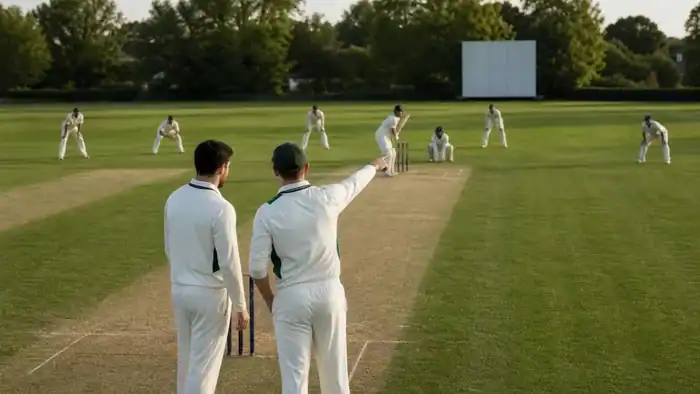
A field is a clue. Before the bowler starts the run-up, it shows which scoring areas the captain is protecting, which mistake the bowling side expects and where a lower-risk run may be available.
Reading the field does not mean planning a shot regardless of the ball. It means narrowing your options so the final decision can be faster and calmer.
Use a Five-second Scan
- Count close catchers and boundary riders.
- Notice whether off side or leg side is more protected.
- Find the largest safe single.
- Check whether a fielder has moved since the previous ball.
- Return your eyes to the bowler.
Do this before taking guard, not while the bowler is releasing the ball.
Start with the Dismissal the Field Suggests
Slips and a gully suggest the bowler wants an outside edge. A short leg or leg slip may indicate a plan into the body or turn toward the batter. A deep square leg with fine leg back can support short bowling. These are clues, not guarantees.
Ask: “What delivery makes this field logical?” Then remain ready for the bowler to use a variation.
Separate Open Space from Safe Space
A vacant area is not automatically a good scoring option. Reaching for a wide ball to hit an empty cover region may bring an edge into play. A controlled push into a smaller gap near the body can be safer.
Judge a gap using three questions:
- Can my normal shot access it?
- Does the expected line allow that shot?
- If I mistime it, what is the likely consequence?
Read Common Field Patterns
| Visible pattern | Possible bowling plan | Batter’s first response |
|---|---|---|
| Slips, gully, protected cover | Fourth-stump line and movement away | Know off stump; leave and defend late |
| Midwicket and square leg saving one | Straighter line into the body | Stay aligned; look for a controlled straight option |
| Deep square leg and fine leg back | Short-ball plan | Expect bounce; choose control before attack |
| Long-on and long-off back to spin | Invite a lofted straight shot | Look for a push into the ring or a safer square gap |
| Ring field with one obvious gap | Tempt a premeditated shot | Confirm the ball before committing |
Watch the Fielder Who Moved
A late change often reveals the next plan. If fine leg goes back and square leg comes up, the bowler may be changing length or line. Captains also use movement as a bluff, so treat it as information rather than certainty.
Find the Single Before the Boundary
In limited-overs cricket, the easiest way to disturb a fielding plan can be a low-risk single. Look for a fielder on the edge of the circle, a slow mover or two fielders protecting the same angle. A soft push followed by a clear call can force the captain to adjust.
Our guide to cricket fielding positions can help newer players learn the position names used in this analysis.
Use the Non-striker’s View
The non-striker can see angles that are harder to judge from the batting crease. Between balls, share one short piece of information: “cover went wider,” “mid-on is deep,” or “point is saving one.” Avoid a long discussion that overloads the striker.
Practice with Freeze-frame Scenarios
Pause a legal match clip before the bowler releases the ball. Draw the field or list the visible positions. Predict the likely line and identify two low-risk scoring areas. Then watch the delivery and update your reasoning.
You can also place cones as fielders during nets. Give the batter one point for identifying the intended gap and one for making a shot decision that fits the ball. A boundary through the wrong area is not always good execution.
Pre-ball Routine Example
Imagine a right-arm seamer bowling over the wicket with two slips, gully, point, cover, mid-off, mid-on, square leg and fine leg. The field suggests protection for the edge and straight drive, with a possible single near square leg. Your plan might be: leave outside off, defend under the eyes and take the leg-side single only when the ball is on the pads.
That plan lasts one ball. Scan again after every change of bowler, field or strike.
The Key Principle
Field awareness should improve shot selection, not replace ball awareness. Read the field early, form a simple plan and then play what is actually delivered.

Leave a Reply