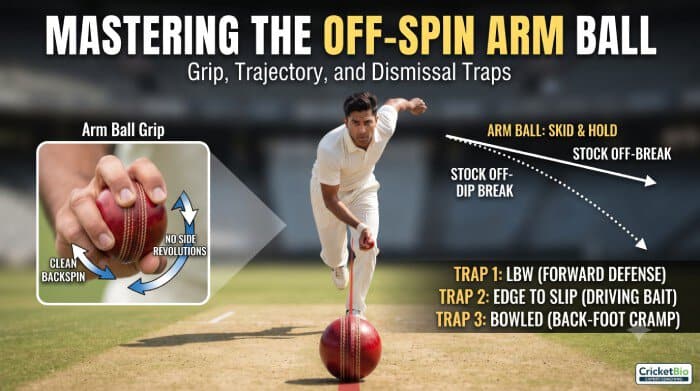
Every successful finger spinner needs a delivery that plays with the batter’s expectations. When an off-spinner gets the ball to grip and bite off the deck consistently, batters adjust their footwork to cover the turn. That expectation is where the arm ball does its damage.
The arm ball is not designed to turn. Instead, it follows the angle of the bowling arm, skids on at pace, and either holds its line or drifts away into right-handers. When delivered with identical arm speed, it catches batters playing for spin that never arrives, leading to LBWs, bowled dismissals, and faint edges to slip.
Setting this delivery up requires more than just pushing the ball through quicker. It demands discipline with the seam, subtle finger pressure, and setting tactical field placements for spin bowlers to force the batter into false footwork.
The Science Behind the Arm Ball
A standard off-break is delivered by cocking the wrist and ripping the index finger down the side of the leather, creating side-spin and over-spin. The seam rotates horizontally, grabs the pitch surface upon landing, and breaks back into the right-hander.
The arm ball flips this dynamic:
- The Seam Angle: The seam stays scrambled or points slightly toward the cordon or fine leg, behaving like a seam bowler’s delivery.
- The Rotation: Instead of sideways revolutions, the ball has backspin or slight angular rotation.
- The Velocity Differential: It is delivered roughly 3 to 5 km/h quicker than your standard stock ball, preserving forward momentum rather than decelerating on pitch contact.
- Air Drift: Because backspin interacts cleanly with the air, the ball holds its line or drifts in the direction of the arm angle rather than dipping and gripping into the turf.
The Grip and Release Mechanics
Getting the arm ball right requires deceiving the batter at release. If your action changes noticeably, a set batter will easily spot the variation and adjust backward to cut or pull.
1. The Finger Placement
- Take your conventional off-spin grip with the index and middle fingers spread across the seam.
- For the arm ball, position the seam upright, running along the length of your index finger rather than completely across the pads of both fingers.
- Tuck your thumb firmly underneath the ball for direct base support.
2. The Wrist Snap and Finger Roll
- Lock the wrist firm at delivery stride. Do not allow your wrist to cock inward as you would for a conventional off-break.
- Instead of ripping your fingers sideways around the ball, drive your index finger directly through the back of the seam.
- Roll the middle and index fingers forward, imparting clean backspin so the ball slides through the air with the seam presenting upright.
3. Body Alignment and Follow-Through
- Push your delivery stride marginally forward to get closer to the batter’s eye-line.
- Pull your non-bowling arm down firmly to generate extra forward drive through the crease.
- Follow through toward your off-side target instead of rotating your torso violently toward the leg side.
Match Study: Ravichandran Ashwin
Ashwin does not push his arm ball into the pitch. He keeps his wrist high, drops his bowling shoulder through the line of the stumps, and lets the ball slide with the seam bolt-upright. The batter commits forward, waiting for the turn that never happens, and gets pinned in front of middle stump.
Understanding the Trajectory: Flight vs. Under-Cutter
Not all arm balls behave the same way. Elite spinners use two distinct trajectories depending on pitch conditions and the batter’s footwork:
| Delivery Style | Trajectory & Movement | Ideal Pitch Condition | Target Area |
|---|---|---|---|
| The Classic Floater | Looped slightly above eye-line, drifts out, holds straight line | Dry, turning tracks with strong wind | Outside off-stump, inviting an expansive drive |
| The Skiddy Under-Cutter | Flatter trajectory, minimal flight, darts low through the gate | Hard pitches or low, uneven surfaces | Base of off-and-middle stumps |
Q.1: The Floater
You release this delivery with regular loop. The ball drifts in the air with the natural angle of your arm, but once it pitches, it glides on straight instead of turning. When batters commit to an expansive drive, thinking the ball will drift outside off and turn back in, they end up finding the outside edge to slip or the keeper.
Q.2: The Under-Cutter
Here, the ball is delivered flatter with the fingers sliding underneath the leather. It stays exceptionally low upon landing and gathers pace off the pitch, catching batters late on the back foot.
Dismissal Traps: Setting Up the Batter
An arm ball bowled in isolation rarely takes wickets. Its effectiveness comes from the sequence of deliveries bowled before it.
Trap 1: The Preconditioned Forward Defense
- The Setup: Bowl three to four consecutive stock balls on off-stump, getting each one to bite and turn into the right-hander. This forces the batter to play with soft hands and lean forward toward cover.
- The Delivery: Push the arm ball through on the same length and line, but with backspin.
- The Result: The batter leans forward to play for turn, leaves a gap between bat and pad, and gets bowled or trapped plumb LBW.
Trap 2: The Driving Bait
- The Setup: Toss two slower off-breaks wide of off-stump, forcing the batter to stretch out and defend.
- The Delivery: Bowl the classic floater, angling across from around the wicket or wider on the crease.
- The Result: Sensing a boundary ball, the batter attempts an aggressive cover drive. Without turning back in, the ball holds its line, takes the outside edge, and carries to the slip cordon.
Trap 3: The Back-Foot Cramp
- The Setup: Bowl slightly shorter lengths to force the batter to rock onto the back foot to punch through the off-side.
- The Delivery: Slip the skiddy under-cutter on a good length at the off-stump line.
- The Result: The batter expects the ball to bounce and turn, but it skids low off the pitch, beating the bat before the downswing completes.
Common Mechanical Faults to Avoid
- Dropping Your Arm Speed: If you deliberately slow your arm down or speed it up drastically, the batter will read the variation instantly. The speed variation must come from finger release and backspin, not a rushed bowling action.
- Pushing the Ball Down Leg: Over-rotating your shoulders during the follow-through pulls the ball down the leg side, giving away easy singles or boundary deflections. Keep your chest aligned with off-stump until the ball is gone.
- Telegraphing the Delivery Through the Crease: Do not alter your approach or run wide of the crease to create an artificial angle. High-level batters spot this immediately. Bowl from your standard release lane and let your wrist mechanics do the work.
The Seam Stability Drill
To confirm your release is clean, draw a thick marker line around the circumference of a white practice ball.
Stand four yards away from a wall or net. Release the ball using your arm-ball grip:
- If the line rotates cleanly like a coin rolling across a flat table, your finger pressure is balanced.
- If the line wobbles or turns sideways, your wrist is twisting at release, which turns the ball into a loose, flat off-break.
Consistent practice with proper gear is essential for mastering finger control. Browse our complete cricket equipment buying guides to select the right match-grade practice balls and training essentials to elevate your bowling craft.

Leave a Reply