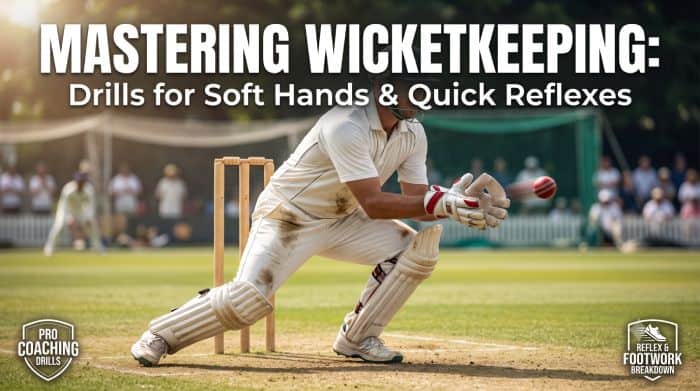
Wicketkeeping is the most unforgiving discipline in cricket. A batter can misjudge a drive, play and miss, and still bat for another three sessions. A wicketkeeper can take five catches over ninety overs, but if you snatch at one thick edge and spill it, that missed chance is all anyone remembers.
After a decade behind the stumps across fast, bouncy decks and spinning dustbowls, one technical truth becomes clear: great glove-work is built on quiet feet, relaxed wrists, and soft hands.
When young keepers snatch at the leather, the ball ricochets off the palm web instead of settling in the pocket. To stop dropping edges and build explosive lateral reaction time, here are five field-tested wicketkeeping drills designed to sharpen your reflexes and cushion every ball.
The Biomechanics of “Soft Hands”
The phrase “soft hands” does not mean being slow or passive. It is an active mechanical deceleration.
When a 140 km/h delivery feathers an outside edge, it reaches your gloves in a fraction of a second. If your elbows are locked and your wrists are stiff, you present a brick wall to the ball. The impact forces the ball outward.
True soft hands require:
- Loose Elbow Hinges: Keeping your elbows slightly flexed inside your torso line so your forearms can give backward upon contact.
- Relaxed Webbing: Holding the thumbs together and fingers pointing downward toward the ground, letting the leather drop deep into the web between the thumb and index finger.
- The Cushion Movement: Absorbing the ball into your hip or navel area as you catch it, dissipating the ball’s momentum rather than fighting it. Practicing this is also the best defense against common finger and hand injuries.
Drill 1: The Blind Deflection Drill (Edges & Instincts)
This is the ultimate drill for eliminating anticipation and training pure reflex action for faint nicks.
[Feeder with Stumps/Bat] -----> Hits Deflection Ramp -----> [Keeper in Crouched Posture]
                                                              (Reacts to late deviation)
How to Set It Up
- Position yourself in your standard crouched stance roughly 8 to 10 yards back from the popping crease.
- Place a deflection ramp, a wet plastic boundary cone, or an old bat angled flat on the turf halfway between you and the feeder.
- A coach or teammate throws underarm or hits balls with a tennis racket straight into the ramp.
Execution
- Stay low in your crouch until the ball makes contact with the obstruction.
- The obstruction will spit the ball at random angles, either skidding low or kicking up toward your shoulder.
- Do not guess the line early. Let the ball hit the ramp first, then thrust your head and gloves behind the path of deviation.
- Volume: 4 sets of 15 deflections.
Match Insight: When keeping to extreme pace, edges do not travel in straight lines. They wobble and dip. By forcing yourself to react only after the ball hits the deflector, you break the dangerous habit of pushing your hands out toward the ball before it arrives.
Drill 2: Barehand Tennis Ball Wall Drills (Wrist Cushioning)
If you rely purely on padded gloves, you cannot feel the natural cradle of your fingers. Stripping away the gloves reveals whether your hands are truly soft or rigid.
How to Set It Up
- Stand 3 to 4 meters away from a brick or concrete wall without your keeping gloves.
- Use a regulation tennis ball or a high-bounce reaction ball.
Execution
- Assume your wicketkeeping ready position with your weight resting on the balls of your feet.
- Throw the ball firmly against the wall at varying heights, aiming between knee and waist level.
- Collect the rebound with both hands, focusing on pulling your palms back toward your ribs the millisecond the ball touches your skin.
- Listen closely: if the catch makes a loud slap against your skin, your hands are too rigid. The catch should be virtually silent.
- Volume: 50 catches daily before every net session.
Drill 3: Standing Up to Spin (The Blind Snick & Stumping Drill)
Standing up to the stumps requires razor-sharp reflexes because you lose the luxury of distance. You have to read variations like the off-spin arm ball
without standing up too early and losing sight of the bounce.
How to Set It Up
- Place a set of stumps on the crease.
- Have a batter stand in their normal stance with their bat held still to block your direct line of sight.
- The feeder stands 10 to 12 yards away and delivers spinning leather balls from an underarm release or side-arm thrower.
Execution
- Keep your head locked directly outside the off-stump line, peering over the batter’s back shoulder.
- Do not rise out of your crouch until the ball passes the batter’s legs.
- If the batter misses, collect the ball cleanly right off the stumps and snap the bails off in one continuous motion without taking your hands backward.
- Volume: 3 sets of 12 deliveries (alternate between off-spin and leg-spin deliveries).
Pro Tip: Keepers often commit the mistake of rising as soon as the ball pitches. When bowling on turning tracks with tactical field placements for spin bowlers, the ball often stays lower than expected[cite: 2, 3]. Stay down with the bounce; your hands follow your eyes, so if your head rises, your hands rise with it, leaving the bottom of the stumps exposed.
Drill 4: Lateral Cone Shuffles (Footwork Before Gloves)
Gloves do not take catches; your feet put your gloves in position to take catches. If your footwork is slow, you will end up diving off-balance for balls you should be gathering comfortably on your chest.
How to Set It Up
- Place three cones in a horizontal line, spaced 1.5 meters apart.
- Stand behind the center cone in your active crouch.
Execution
- On the coach’s call, shuffle rapidly to the left cone using short, explosive side-steps without crossing your feet.
- Catch an incoming feed thrown outside your left knee, absorb the ball, and toss it back.
- Immediately shuffle across past the middle cone to the right cone to take a low feed outside your right toe.
- Keep your nose aligned over your knees throughout the entire lateral sequence.
- Volume: 6 rounds of 30-second continuous lateral shuttles.
Drill 5: The Squash Ball Rapid-Fire Reflex Drill
Squash balls are smaller, lighter, and travel with erratic speed. Training with smaller equipment expands your margin of error when you put on match gloves.
How to Set It Up
- Wear your inner wicketkeeping gloves or standard match gloves.
- Have a training partner stand 5 meters away holding three squash balls or mini reflex balls.
Execution
- Your partner rapidly fires balls underarm at alternating sides, chest, and knee height, releasing the next ball the moment you gather the previous one.
- Focus on quick hand reset. As soon as you secure one catch, toss it aside and snap your hands back to the central catching cradle position.
- Volume: 4 sets of 20 rapid-fire catches.
Wicketkeeping Drills Quick Comparison
| Drill Name | Primary Skill Developed | Equipment Needed | Repetition Target |
| Blind Deflection | Reflex reactions to thick outside edges | Keeping gloves, deflection board/bat | 4 sets of 15 balls |
| Barehand Wall Toss | Soft-hand cushioning & wrist relaxation | Tennis ball, concrete wall | 50 catches daily |
| Standing Up Blind | Delayed rise, stumping speed against spin | Full keeping gear, stumps, batter | 3 sets of 12 balls |
| Lateral Cone Shuffle | Quick footwork, head-over-knee balance | 3 training cones, leather balls | 6 sets of 30 seconds |
| Squash Ball Rapid-Fire | Hand speed, reset quickness, tracking | Inner gloves, 3 squash balls | 4 sets of 20 catches |
3 Costly Technical Mistakes Keepers Make
1. Snatching Outward at the Ball
Reaching toward the bowler tightens your forearms and turns your palms into hard surfaces. Wait for the ball to travel to your catching zone. Let the ball come to you; do not go hunting for it unless you are closing down an intentional stumping chance.
2. Rising Too Early from the Crouch
Standing up before the ball reaches the hitting area lifts your center of gravity. When a delivery stays low or takes an under-edge, your hands cannot drop fast enough to make the save. Stay seated in your crouch until the ball either hits the bat or clears the stumps.
3. Crossing Your Legs During Lateral Movement
When an edge flies wide of the slips, crossing your feet locks your hips and removes your ability to dive. Use explosive lateral shuffles so you remain balanced and primed to push off either foot at a split second’s notice.
Gear and Training Preparation
Maintaining razor-sharp focus behind the stumps over 50 or 90 overs requires physical stamina and proper protective equipment. High-grade inner gloves absorb sweat and reduce palm friction, while fitted footwear keeps your ankles stable during rapid lateral shuffles.
If you are gearing up for the upcoming season, review our detailed guide on the best cricket kit for beginners to pick out match-tested gear, padding, and training balls that protect your hands while you hone your craft[cite: 2, 3].

Leave a Reply