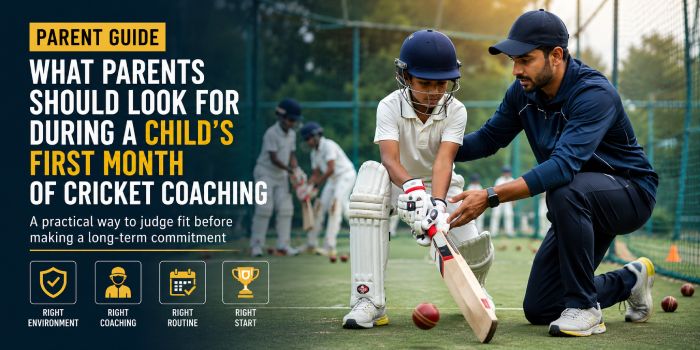
What Parents Should Look for During a Child’s First Month of Cricket Coaching
A practical way to judge fit before making a long-term commitment
A parent often leaves a trial session asking one question: Did my child bat well? It is understandable, but it is usually the wrong question. A first cricket class is too short to judge technique, talent or future potential. It is much better at showing whether the environment gives the child a fair chance to learn.
At LyfSkills, I see parents compare academies through fees, distance, facilities and reputation. Those details matter, but the first month reveals what a listing or brochure cannot. It shows how the coach works with beginners, how the child responds to correction and whether the weekly routine is realistic for the family.
Begin with comfort, not performance
A new player may barely touch the ball in the first class. Another child may appear confident because they already play in the neighbourhood. Neither response tells you much on its own. Instead, watch whether your child is willing to join the group, ask a question, try again after missing the ball and return for the next session without dread.
Some hesitation is normal. The useful signal is whether it reduces over two or three sessions. A good beginner environment gives children enough structure to feel safe without expecting them to behave like experienced players from day one.
Watch how the coach handles ordinary mistakes
The coach’s response to a missed catch or an incorrect grip tells you more than a polished demonstration. Does the coach explain one correction clearly? Does the child get another attempt? Is feedback specific, or is the player simply told to do better?
Also observe how much time children spend waiting. Cricket naturally involves turns, but a large batch should still have a plan that keeps players moving through fielding, bowling and batting stations. Long periods of standing around every week usually mean the batch is too large or the session is not well organised.
Check whether the level suits the child
Parents sometimes choose the most competitive academy available, assuming that a tougher environment will produce faster progress. For a beginner, that can backfire. If drills move too quickly, the child spends the session copying others without understanding what to do. If the level is too easy, they stop paying attention.
A useful starting point is to compare cricket academies in India by age group, training level, batch format, location and trial availability. The final decision should still come from what you observe during the first few sessions, not from the academy name alone.
Look for small signs of learning
Progress in the first month should be modest and visible. A child may begin to stand in a more balanced position, watch the ball for longer, remember where to place the hands for a catch or understand why a warm-up matters. These are better early indicators than the number of boundaries hit in a net.
Ask the child one simple question after class: What did you work on today? If the answer becomes clearer over time, the coaching is probably giving them something they can understand and retain. If the answer is always ‘we played cricket,’ ask the coach what the current learning goal is.
Do not rush the full kit
A beginner does not need the most expensive bat in the shop. For the first few sessions, ask the academy what it provides and what the child genuinely needs to bring. When it is time to buy, correct size and comfort matter more than brand or grade of willow. A bat that is too heavy can make a child late on every shot. Oversized pads and gloves can make basic movement frustrating.
If leather-ball training begins, proper protective equipment is not optional. Confirm how the academy manages helmets, guards, net safety and supervision before the child enters a hard-ball session.
Make sure the routine works outside the academy
A technically good programme can still be the wrong fit if reaching it requires a long rush after school, late meals and a tired child the next morning. Cricket sessions are often longer than many other children’s activities. Add travel, changing time and weekend matches before deciding whether the schedule is sustainable.
Consistency matters more than choosing the academy with the longest sessions. A child who attends regularly, rests properly and arrives ready to learn is likely to gain more than one who is enrolled in an impressive programme the family struggles to maintain.
Review the fit after four weeks
After roughly a month, speak to both the child and the coach. Keep the conversation practical. Three questions are enough:
- What does the child enjoy, and what still makes them uncomfortable?
- What is one skill the coach is currently helping them improve?
- Does the child want to continue for the next month?
You are not looking for a promise that your child will become a competitive cricketer. You are checking for a healthy learning loop: the coach notices the child, the child understands what to practise, and the family can support the routine without turning every session into pressure.
That is enough for the beginning. Cricket has room for ambition, but the first job is simpler: help the child feel safe, interested and willing to return. The rest can be built one session at a time.
About the author
Sumit Kapoor is the founder of LyfSkills, a discovery and booking platform that helps Indian families compare children’s classes, sports coaching and activities closer to home.

Leave a Reply