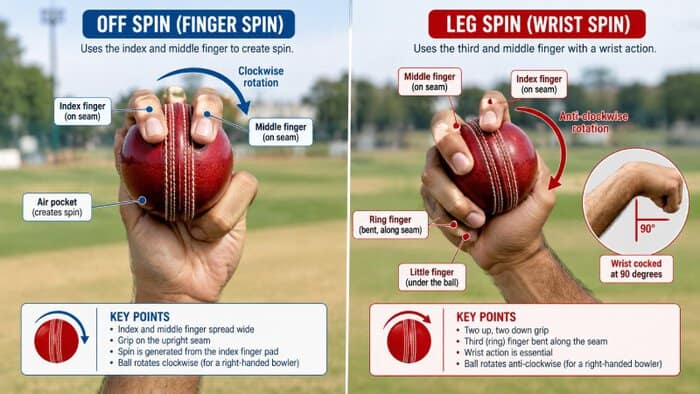
Spin bowling is an art of deception. For over a decade on competitive pitches, whether bowling on red clay or dry composite wickets, one reality stays true: deception does not happen at the pitch, it begins at your fingertips and wrist.
Batters pick spinners in the air before the ball even pitches. If you get your grip, wrist cock, and revolution axis wrong, you will produce floaty, toothless deliveries that sit up to be hammered.
Understanding the fundamental battle between wrist spin (leg spin) and finger spin (off spin) requires stripping down the exact hand mechanics that govern how each ball spins off the deck.
Finger Spin vs. Wrist Spin: How Revolutions Work
The defining contrast between off spin and leg spin comes down to how force is transferred into the seam.
1. Off Spin (Finger Spin)
- Primary Engine: The index finger.
- Axis of Rotation: Clockwise rotation for a right-arm bowler.
- Biomechanics: The bowler rotates the forearm outward (supination) while pulling the index finger sharply down the side of the leather.
- Revolutions & Flight: Finger spinners generally generate fewer revolutions per minute than wrist spinners, but they gain superior control over trajectory, dip, and seam stability. The ball turns inward toward a right-handed batter.
2. Leg Spin (Wrist Spin)
- Primary Engine: The wrist combined with the third finger (ring finger).
- Axis of Rotation: Anti-clockwise rotation for a right-arm bowler.
- Biomechanics: The wrist uncoils violently from a cocked position, with the ring finger cutting across the seam as the ball exits the hand.
- Revolutions & Flight: A properly executed leg break generates significantly higher revolutions per minute. This produces sharp aerodynamic drift through the air and aggressive turn away from a right-handed batter.
Step-by-Step Breakdown: The Off-Spin Grip & Release
Off spin is built on repeatable control. An off-spinner relies on tight lines, teasing length, and coordinated field placements for spin bowlers to strangle scoring options.
1. The Conventional Off-Break Grip
- Finger Spread: Spread your index and middle fingers wide across the seam. The seam should sit directly across the first pads of both fingers.
- The Power Finger: Your index finger applies 80 percent of the rotational force.
- Thumb Position: The thumb rests gently against the side or underneath the leather. Keep it relaxed. Pressing your thumb into the leather chokes the ball and kills rotation.
- The Palm Gap: Never press the leather flat against your palm. Maintain a clear air gap between the ball and your palm so only your fingers contact the leather.
2. Wrist Position and Release
- Enter the delivery stride with your wrist firm and slightly flexed.
- As your bowling arm reaches vertical release, snap the wrist inward and rip the index finger down the right side of the ball.
- Think of it like turning a doorknob quickly to the right or opening a tight jar lid.
- Follow through completely with your bowling hand finishing across your body toward your opposite pocket.
Match Example – Ravichandran Ashwin: Notice how Ashwin keeps his fingers spread wide across the leather, driving his index finger over the seam at release. This generates steady overspin, causing the ball to dip late below the batter’s eye-line before turning into the stumps.
Step-by-Step Breakdown: The Leg-Spin Grip & Release
Leg spin is high-risk, high-reward. While it is more difficult to control than off spin, its steep bounce and venomous sideways bite make it a pure strike weapon.
1. The Two-Up, Two-Down Grip
- Finger Setup: Place the index and middle fingers along the seam, held comfortably apart.
- The Working Finger: Bend your ring finger (third finger) along the seam. The seam must sit firmly against the first joint of your ring finger. The little finger rests loosely alongside it.
- Thumb Placement: Rest the thumb lightly on the ball without gripping tight.
- Palm Clearance: Like off-spin, preserve a clear pocket of air inside the palm. A buried ball cannot roll freely.
2. Wrist Position and Release
- Cock your wrist 90 degrees backward and inward toward your forearm during the delivery stride.
- At the moment of delivery, flick the wrist open. The back of your hand should finish facing toward the cover boundary.
- The ring finger works like a trigger, flicking upward and across the seam as the ball rolls out over the outside of the hand between the ring finger and pinky.
Match Example – Shane Warne: Warne’s legendary turn came from his explosive wrist uncoiling. His ring finger literally tore across the seam at release, imparting massive side-spin that caused the ball to drift toward the off-side before biting hard off the deck.
Side-by-Side Technical Comparison
| Feature | Off Spin (Finger Spin) | Leg Spin (Wrist Spin) |
| Primary Lever | Index finger | Wrist and ring finger |
| Grip Style | Two fingers spread wide across the seam | Two fingers up, ring finger bent along the seam |
| Ball Exit Point | Off the index finger (inside of the hand) | Past the ring finger (outside of the hand) |
| Natural Direction of Turn | Into right-handers (Off to Leg) | Away from right-handers (Leg to Off) |
| Average Revolutions | Moderate (approx. 1,600 to 2,000 RPM) | High (approx. 2,000 to 2,500+ RPM) |
| Primary Danger | LBW, bowled through the gate, short leg catches | Outside edges to slip, bowled behind the legs, stumpings |
4 Common Grip Errors (And How to Correct Them)
Error 1: Choking the Ball in the Palm
- The Problem: Burying the ball deep in the palm removes finger leverage, leading to flat, spin-less deliveries that sit up on good length.
- The Fix: Hold the ball using finger pads only. You should be able to slide a pencil freely between the ball and your palm.
Error 2: Stiff Wrist in Leg Spin
- The Problem: Bowling leg spin without cocking the wrist forces the shoulder to push the ball, producing low full tosses or floaty half-trackers.
- The Fix: Stand still and practice spinning the ball up into your own hand, focusing entirely on snapping the wrist and flicking the ring finger without moving your shoulder.
Error 3: Pinching the Thumb
- The Problem: Squeezing the ball tight with the thumb acts as a brake, killing backspin and drift.
- The Fix: Rest the thumb lightly against the leather. It is a stabilizer, not a clamp.
Error 4: Inconsistent Seam Alignment
- The Problem: Allowing the seam to wobble sideways through the air prevents the ball from biting the pitch surface.
- The Fix: Focus on imparting clean revolutions so the seam spins upright. Using a marked two-tone practice ball helps you evaluate spin stability instantly.
Having the right leather ball is critical for developing real finger calluses and seam grip. Review our best cricket kit for beginners to equip yourself with match-grade training balls and gear.
The Seam-Rotation Practice Drill
To build muscle memory without fatiguing your shoulder, try the Kneeling Spin Drill:
- Kneel on your bowling-side knee, roughly three yards away from a partner or padded wall.
- Without taking a run-up or using excessive arm swing, isolate your wrist and fingers.
- Release the ball at eye-level, focusing entirely on the rotation:
- For off spin, see the ball seam turn over in a clean, sharp clockwise roll.
- For leg spin, verify that the seam rotates diagonally across, kicked outward by the ring finger.
- Perform 3 sets of 20 clean repetitions before every net session. Control the grip first, and the wickets will follow.

Leave a Reply