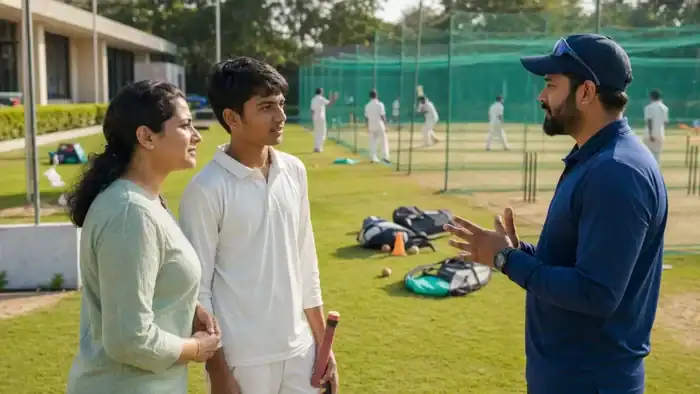
Junior cricket should be challenging, enjoyable and appropriately supervised. Parents do not need to become coaches or clinicians, but they can ask clear questions about equipment, workloads, weather and emergency planning.
This checklist is a conversation guide, not a substitute for the current rules of your national board, state association, school or club. Requirements differ by age, competition and location.
Before registering with a club or academy
- Confirm who is responsible for safeguarding and how concerns are reported.
- Ask whether coaches have role-appropriate qualifications and whether background checks are required locally.
- Check the adult-to-player supervision arrangement.
- Ask how injuries, illness, allergies and emergency contacts are recorded.
- Confirm the process for collection, travel and handover of children.
Our guide to choosing a cricket academy in India includes additional questions about coaching quality, fees and trial sessions.
Protective equipment check
| Item | Parent check |
|---|---|
| Helmet | Correct size, secure fit, undamaged shell and grille position set for the player |
| Abdominal protector | Appropriate type and comfortable, secure fit |
| Pads and gloves | Correct size, sound straps and no damage that reduces protection |
| Footwear | Suitable for the surface and in usable condition |
| Additional guards | Thigh, arm, chest or other protection selected for role and competent advice |
A helmet is safety equipment, not a lifetime purchase. Follow the manufacturer’s care and replacement guidance, and replace equipment after significant impact when advised. Do not modify a helmet or grille at home.
Hard-ball readiness
Moving from soft-ball or tennis-ball cricket to a leather ball should be progressive. The child needs suitable coaching, protective equipment and a controlled environment. Age alone does not prove readiness.
Before the first session, ask who will deliver the ball, at what pace and from what distance. A qualified coach should control the progression.
Fast-bowling workload
Young fast bowlers need age-appropriate limits and adequate recovery. Ask the coach which current governing-body guidance the program follows and how school, club, academy and informal bowling are counted together.
A diary can record overs, high-intensity training, matches and discomfort. The aim is not for parents to prescribe a medical program, but to prevent separate teams from unknowingly adding excessive load.
Heat, hydration and air quality
- Send a labelled drink bottle and encourage regular opportunities to drink.
- Use suitable clothing, shade and sun protection for local conditions.
- Ask what triggers extra breaks, shorter sessions or cancellation.
- Tell the supervisor about illness or medication that may affect participation.
- Check local weather and air-quality advice when conditions are severe.
Children may not always recognise or report heat illness early. Confusion, collapse, severe weakness or worsening symptoms require immediate adult action and appropriate medical help.
Concussion and head impacts
A player with a suspected concussion should be removed from play and assessed according to the competition’s current concussion protocol. They should not be encouraged to “push through” symptoms or return simply because they feel better after a few minutes.
Parents should know who documents the incident, who decides return to sport and how school activity is considered. Seek urgent medical care for severe or worsening symptoms.
Training-area safety
- Nets are intact and entrances are controlled.
- Players waiting to bat stand in a protected area.
- Loose balls and equipment do not create trip hazards.
- Throwdowns and bowling machines are operated only by competent adults.
- Players wear the required protection before entering a live hard-ball lane.
Match-day parent checklist
- Share current medical information and emergency contact details.
- Inspect essential equipment before leaving home.
- Pack fluids, suitable food, sun protection and any prescribed medication.
- Confirm venue, transport, collection time and supervising adult.
- Tell the coach about recent pain, illness or a significant increase in workload.
- After play, ask open questions: “How did your body feel?” and “Was anything worrying?”
When to stop and get help
Stop participation for severe pain, breathing difficulty, collapse, confusion, suspected head or neck injury, obvious deformity or symptoms that worsen during play. Use local emergency services when the situation is urgent.
For recurring pain, altered bowling or batting movement, or symptoms that do not settle, seek assessment from an appropriately qualified healthcare professional. Children should not conceal pain to keep their place in a team.
Keep the child involved
Safety works best when young players understand why a rule exists. Teach them to check their own helmet strap, report a damaged glove, ask for water and speak up about pain or unsafe behaviour. That is part of becoming a responsible cricketer.
Important: Always follow the most recent safety, safeguarding, concussion and workload rules issued for your child’s competition and location. This general checklist does not provide individual medical advice.

Leave a Reply