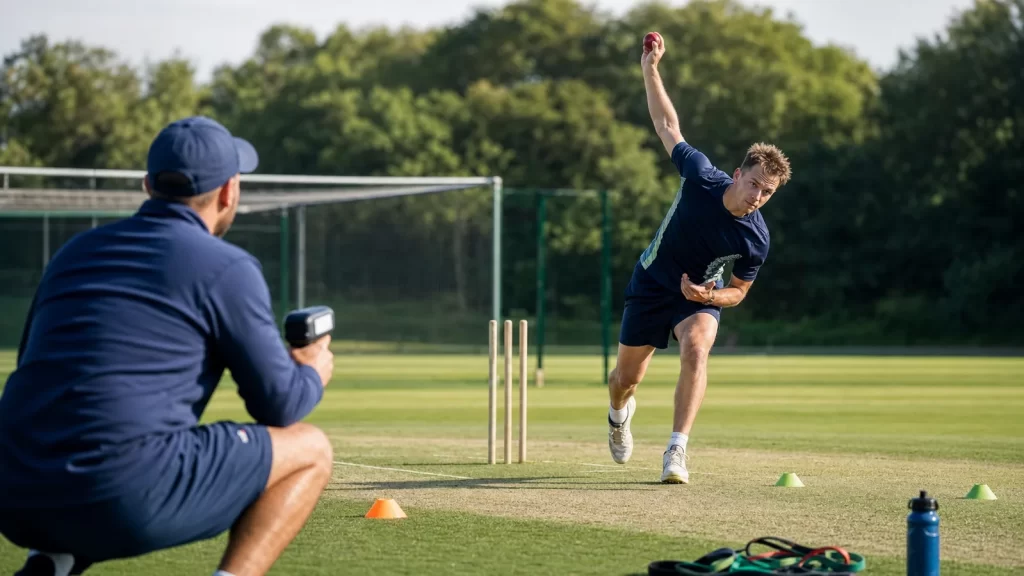
Bowling faster is not simply a matter of running in harder. Pace comes from a repeatable approach, efficient force transfer and enough physical capacity to maintain the action. When effort rises, but timing breaks down, speed and accuracy can both fall.
This plan supports our detailed guide on how to increase bowling speed. It is intended for healthy adult or late-teen club players. Junior workloads should be set by qualified coaches using age-appropriate guidance.
Before Week One: Record a Baseline
- Measure speed with the same reliable device or method each time.
- Record the best and average speed from six match-intent deliveries.
- Count how many of 18 balls hit a good-length target.
- Note run-up length, perceived effort and any discomfort.
Do not compare readings from different apps or devices as if they are identical. The useful comparison is your result under the same setup.
Weekly Structure
| Day | Purpose | Typical work |
|---|---|---|
| 1 | Technical bowling | Run-up rhythm, target bowling, controlled intensity |
| 2 | Strength and movement | Coach-approved lower-body, trunk and pulling work |
| 3 | Rest or light recovery | Walking, mobility and normal daily activity |
| 4 | Speed exposure | Low-volume, high-quality fast deliveries with full rest |
| 5 | Fielding or light skill | No heavy bowling load |
| 6 | Match or scenario session | Overs with a plan and target |
| 7 | Rest | Review soreness and prepare for the next week |
Week 1: Make the Run-up Repeatable
Mark the starting point and a check point several strides before the crease. Complete six walk-throughs and six run-throughs without delivering the ball. The objective is to arrive balanced, not to attack the crease from the first step.
Bowling work: three sets of six balls at approximately 70% intent. Rest for two minutes between sets. Record front-foot position and target hits.
Week 2: Connect Approach and Release
Add “build-up” deliveries. Start with two at comfortable effort, two at strong match effort and two at high intent. If the action changes dramatically at high intent, return to the previous level.
Use a target on a fourth-stump line. Pace without a usable line is less valuable in a match. Keep the total number of high-intent deliveries low enough that each one has purpose.
Week 3: Short Speed Exposures
After a full warm-up, bowl two sets of four high-intent deliveries with generous rest. Treat each ball like a sprint. Stop the set if speed drops sharply, accuracy disappears or movement becomes uncontrolled.
Follow with 12 controlled target balls. This teaches the bowler to return from maximum intent to a match plan.
Week 4: Match Transfer
Bowl three overs with a defined scenario. For example, defend 24 runs with one new batter and one set batter. Choose a field, write the intended delivery before each ball and score execution separately from the match result.
A Useful Delivery Score
- 2 points: intended line and length
- 1 point: one dimension correct
- 0 points: neither correct
This prevents a lucky wicket from hiding poor execution.
Strength Work: Quality Before Complexity
Fast bowlers need strength through the legs, hips, trunk, back and shoulders, but cricket exercises should suit training age and technique. Squat patterns, split-stance work, hinges, calf strength, rows, controlled presses and anti-rotation trunk work are common foundations. A qualified strength coach should adjust loading and exercise choice.
Recovery Rules
- Do not add high-intensity deliveries simply because a session feels good.
- Avoid sudden jumps in weekly bowling volume.
- Sleep and normal nutrition are part of training, not optional extras.
- Stop for sharp pain, altered movement or pain that worsens as the session continues.
Retest After Four Weeks
Repeat the same speed and accuracy tests. A useful result might be a small bowling speed increase with equal or better target control. If the fastest ball improves but average speed and accuracy collapse, the training has not yet transferred reliably.
Safety note: Fast bowling places substantial load on the body. This article is general information and cannot replace assessment by a qualified cricket coach, physiotherapist or medical professional.

Leave a Reply