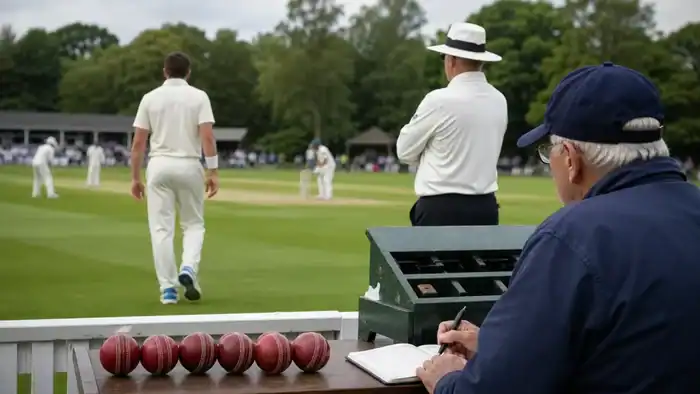
An over is commonly described as six balls, but the more accurate definition is six valid balls delivered by one bowler from one end. That distinction explains why an over may contain seven, eight or more actual deliveries.
For the number of scheduled overs in each format, read how many overs are played in cricket formats. The governing law is MCC Law 17.
What Counts as a Valid Ball?
A delivery counts toward the six-ball over unless the umpire calls a no ball or wide, or another specific provision means it does not count. When a wide or no ball occurs, the batting side receives an extra, and the bowler must deliver another valid ball.
Example Over
| Delivery | Call/result | Valid-ball count |
|---|---|---|
| 1 | Dot ball | 1 |
| 2 | Wide | Still 1 |
| 3 | Single | 2 |
| 4 | No ball | Still 2 |
| 5 | Four | 3 |
| 6 | Dot ball | 4 |
| 7 | Two runs | 5 |
| 8 | Wicket from a valid ball | 6 – over complete |
What is a Maiden Over?
A maiden is an over in which no runs are scored against the bowler. Scorekeeping details matter. Byes and leg byes are team extras rather than runs charged to the bowler, so an over containing only those extras may still be recorded as a maiden for the bowler. Wides and no-balls are charged to the bowler and therefore prevent a maiden.
A wicket-maiden is a maiden over in which the bowler also takes a wicket credited to the bowler. A run-out does not become the bowler’s wicket.
Can an Over Finish Early?
An innings can end before six valid balls are completed for example, when the final wicket falls or a successful chase reaches its target. Weather, an agreed interruption or the conclusion of play can also leave an over incomplete.
Why Bowlers Change Ends
Overs are delivered alternately from the two ends of the pitch. The same bowler cannot bowl consecutive overs. Changing ends affects wind, slope, boundary dimensions, sunlight and how a ball behaves from the surface.
Understanding Over Notation
Cricket notation is not a decimal in the normal mathematical sense. A score shown after 12.4 overs means 12 completed overs plus four valid balls, not 12.4 as a fraction of 100. After two more valid balls, the notation becomes 13.0 overs.
What is Over Rate?
Over rate measures how quickly the fielding side completes its overs. A simple calculation is:
Overs bowled ÷ playing hours = overs per hour
Official calculations may include allowances for wickets, injuries, reviews and other interruptions. Competition playing conditions, not a simple stopwatch alone, determine penalties.
Why Slow Over Rates Matter
- They reduce the amount of cricket spectators receive.
- They can interrupt a batter’s rhythm.
- They may lead to in-match or disciplinary penalties under competition rules.
- They place extra responsibility on the captain and fielding side.
Beginner Scoring Exercise
Watch one over with the scoreboard hidden. Record every actual delivery and circle wides or no-balls. Then write the over notation and bowler figures. Compare your record with the official scorecard. This exercise quickly reveals the difference between deliveries bowled and valid balls counted.
Three Common Misconceptions
“Every over contains exactly six physical deliveries.” Wides and no-balls can increase the number.
“Six balls always equal one run of time.” Reviews, wickets, field changes and game situations make over duration variable.
“12.5 overs is almost 13 overs in decimal form.” It means five valid balls into the thirteenth over.
Once valid balls, extras and notation are clear, scorecards become much easier to read.

Leave a Reply