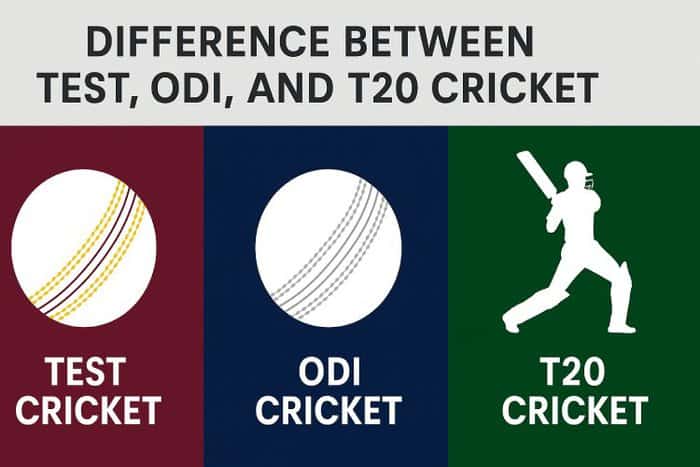
Cricket, often called the gentleman’s game, has evolved over the decades. From timeless Tests to power-packed T20s, each format brings a unique flavour to the sport. Understanding the difference between Test, ODI, and T20 cricket is crucial for fans, aspiring players, and anyone serious about learning the game.
In this expert guide, we break down the formats with technical insights, strategy differences, and key examples—so you walk away not just informed, but cricket-smart.
Introduction to Cricket Formats
There are three official international formats recognized by the ICC (International Cricket Council):
- Test Cricket – The traditional, longest format (up to 5 days)
- ODI (One Day International) – Each team plays 50 overs
- T20 (Twenty20) – The shortest format, 20 overs per team
Each format tests different aspects of skill, temperament, fitness, and strategy.
Head-to-Head Comparison Table
| Feature | Test Cricket | ODI Cricket | T20 Cricket |
|---|---|---|---|
| Overs per Innings | Unlimited | 50 | 20 |
| Innings per Team | 2 | 1 | 1 |
| Duration | Up to 5 days | 1 day (~8 hours) | ~3–4 hours |
| Ball Used | Red | White | White |
| Clothing | White | Colored | Colored |
| Field Restrictions | No | Yes (Powerplays) | Yes (More strict) |
| Result Possibilities | Win/Loss/Draw | Win/Loss/No Result | Win/Loss/No Result |
Strategic Differences
| Format | Batting Strategy | Bowling Strategy | Fielding Focus |
|---|---|---|---|
| Test | Patience, technique, long innings | Consistency, swing, reverse swing | Close catching, stamina |
| ODI | Balance between aggression and defense | Variations, middle-over control | Boundary saving, direct throws |
| T20 | Power hitting, quick runs | Yorkers, slower balls, deception | Acrobatics, quick reflexes |
What is Test Cricket?
Test cricket is the purest and most challenging form of the game, often referred to as the ultimate test of a player’s technique, patience, and endurance.
Key Features:
- Duration: Up to 5 days (with each day having 90 overs)
- Innings: 2 per team
- White clothing, red ball, no music or cheerleaders
- Played with a red Duke, Kookaburra, or SG ball
- Matches can end in draws, unlike other formats
Expert Insight:
Test matches require long concentration spans. Batting for 200 balls or bowling 40 overs a day pushes a cricketer’s physical and mental limits.
What is ODI Cricket?
One Day Internationals (ODIs) balance traditional cricket with limited overs to produce a result in one day.
Key Features:
- Duration: ~7–8 hours (50 overs per side)
- Colored clothing, white ball, floodlights allowed
- Field restrictions in powerplays
- Innings: 1 per team
Expert Insight:
ODI cricket introduced the need for adaptable players – those who can shift gears, rotate strike, and build or chase a total with smart cricket.
What is T20 Cricket?
T20 (Twenty20) is the fastest and most entertaining format, designed to bring fans to the edge of their seats in under 4 hours.
Key Features:
- Duration: 3-4 hours (20 overs per team)
- Explosive batting, creative bowling
- Colored kits, white ball, music, fireworks
- Strategic Timeouts in leagues like IPL
Expert Insight:
T20 has revolutionized cricket. It demands fitness, power-hitting, quick thinking, and fielding brilliance. There’s no room for error, and every delivery counts.
Which Format is Hardest to Master?
While each format tests different skills:
- Test cricket challenges technique, stamina, and mindset.
- ODIs demand adaptability and match awareness.
- T20s push fitness, explosive power, and tactical precision.
A truly great player performs across all three formats – think of Virat Kohli, Steve Smith, or Ben Stokes.
Frequently Asked Questions (FAQs)
Q1: Which format is best for beginners?
A: Start with ODIs or T20s to learn scoring and game flow, then move to Test for deeper skills.
Q2: Why is Test cricket considered the highest form?
A: It tests a player’s technique, temperament, and consistency over multiple days—no shortcuts.
Q3: Are skills transferable between formats?
A: Yes, but each format requires adjustments in mindset, tempo, and technique.
Conclusion
Cricket is no longer just a one-dimensional sport. Whether it’s the endurance of a Test, the strategy of ODIs, or the adrenaline of T20s – each format plays a vital role in shaping modern cricket.
As a cricketer or an informed fan, appreciating these differences makes you smarter and sharper on and off the field.

Leave a Reply