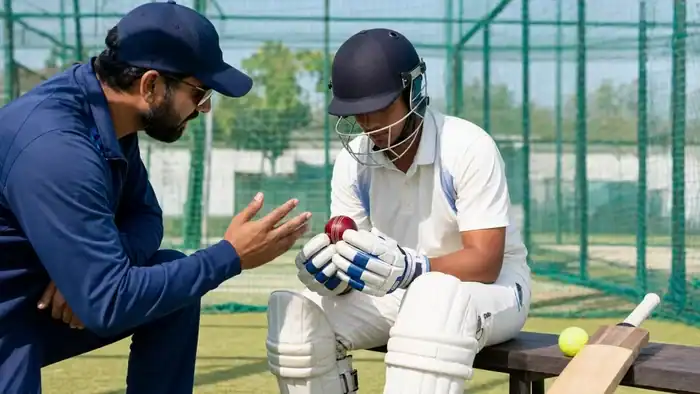
Swing bowling becomes most dangerous when a batter commits before the ball has revealed its path. The answer is not to guess perfectly. It is to create enough time and balance to make a later decision.
Good swing-bowling practice starts with three priorities: know where your off stump is, keep your head aligned and let the ball come closer before your hands take over.
Start with the Correct Expectation
The ball may swing because of its condition, bowling seam presentation, release, weather and speed. From the batting end, you cannot control those factors. You can control your guard, trigger movement, judgement and shot selection.
Watch the bowler’s hand and release, but do not lock onto a predicted direction. Read the early line, then confirm the movement during flight.
Know your Off Stump
Many outside edges begin with uncertainty about which balls threaten the stumps. Take guard, look back at the stumps and build a reliable picture of off stump from your stance. Repeat this before net sessions on unfamiliar pitches.
When the ball starts outside that reference, leaving becomes a positive scoring decision: you have denied the bowler a chance.
Keep the Head Inside your Base
If the head falls toward cover, the bat often follows the ball away from the body. If it falls toward leg side, an inswinger can pass through the gate. Aim to move the head toward the ball while staying balanced enough to stop or adjust the shot.
Your first movement should be small. A large early stride can make a late change impossible.
Play Outswing with Controlled Hands
- Leave balls that do not need to be played.
- When defending, allow the ball to arrive under the eyes.
- Keep the grip relaxed enough that an edge is less likely to carry.
- Avoid chasing width with hard hands early in the innings.
The objective is not to eliminate edges no batter can but to reduce unnecessary contact outside the line of the body.
Play Inswing Without Closing the Gate
Inswing threatens the pads and stumps. Move the front foot toward the line rather than automatically stepping across it. Present a straight bat and keep the front pad from blocking the bat’s path.
Also be ready for the ball that does not swing. Overcompensating for movement can make the straight ball more dangerous.
Drill 1: Coloured-cone Leave Drill
Place a safe visual marker outside off stump. Ask a thrower to deliver underarm or sidearm feeds on different starting lines. Say “play” or “leave” before the ball reaches you, then complete the appropriate movement. Begin without trying to score.
Record the decision, not whether the ball looked impressive. Ten correct decisions from 12 feeds is a useful first benchmark.
Drill 2: One-hand Soft-contact Drill
With gentle feeds and suitable protective cricket equipment, use the top hand to guide defensive contact under the eyes. Reintroduce the bottom hand without squeezing it. This helps a batter feel the difference between control and a hard push at the ball.
Drill 3: Two-gate Swing Simulation
Create one gate on a straighter line and another slightly wider. A coach or skilled thrower calls the intended path only after release, encouraging the batter to wait and react. Keep the speed appropriate to the player’s level.
Build an Innings Plan
| Match phase | Primary aim | Useful response |
|---|---|---|
| First 12 balls | Learn the movement | Leave well, defend late, avoid forcing square drives |
| Bowler misses straight | Score without reaching | Use a balanced clip or straight shot |
| Swing reduces | Expand carefully | Add controlled drives when line and length allow |
For a broader practice structure, combine these exercises with our guide to practising cricket at home. Use only soft-ball drills in spaces that are not designed for hard-ball cricket.
What to Review After the Net
Do not ask only, “How many times was I out?” Note how often you played at a ball that could have been left, whether your head stayed over the contact area and which line caused the earliest commitment. One observation gives the next session a clear purpose.
Safety note: face pace bowling only in a suitable net with correctly fitted protective equipment and competent supervision.

Leave a Reply