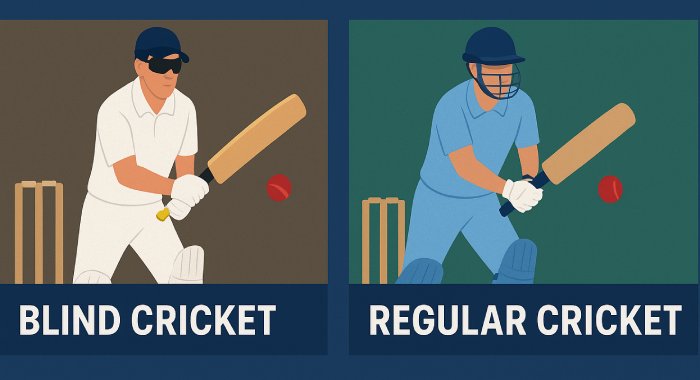
Cricket is one of the most loved sports in the world. But did you know there’s a version of cricket designed specially for the visually impaired?
Blind Cricket, also known as Visually Impaired Cricket, is an inspiring adaptation of the traditional game that allows players with partial or complete vision loss to play competitively — and even represent their country internationally.
In this blog, we’ll explore the key differences between blind cricket and regular cricket, from rules and equipment to techniques and player classifications.
1. Purpose and Accessibility
Regular Cricket is played by sighted players and focuses on visual coordination, timing, and precision.
Blind Cricket, on the other hand, was created to make the sport inclusive for visually impaired individuals. The game is designed around sound, touch, and teamwork, enabling every player to contribute meaningfully on the field.
2. The Ball Used
This is one of the biggest differences.
- Regular Cricket Ball:
Made of hard leather, weighs about 156 grams, and has a solid core.
It requires sight and reflexes to hit or catch. - Blind Cricket Ball:
Made of hard plastic and filled with ball bearings that produce a rattling sound.
This sound helps players locate the ball by hearing, making it possible to react and field effectively.
3. Player Classification
Players in Blind Cricket are classified based on their level of visual impairment:
- B1 (Completely Blind): No light perception at all.
- B2 (Partially Sighted): Can detect shapes but not details.
- B3 (Low Vision): Can see up to a certain distance but still impaired.
Each team must have a specific combination of these categories to maintain balance – usually 4 B1, 3 B2, and 4 B3 players.
4. Pitch and Ground
While Regular Cricket is played on a 22-yard pitch, Blind Cricket uses a slightly shorter pitch (16–18 yards) to make it easier for players to judge distances through sound and movement.
The boundary is also shorter, typically around 40–50 meters compared to 65–75 meters in standard cricket.
5. Bowling Technique
In regular cricket, bowlers deliver the ball overarm, often at speeds exceeding 140 km/h.
In blind cricket:
- Bowling is underarm, allowing the ball to roll or bounce low.
- The bowler must say “Play” before delivering the ball, so the batsman can track its direction by sound.
- The ball must bounce at least twice before reaching the batsman.
This ensures fairness and gives the batsman adequate time to react.
6. Batting Rules
Batting in blind cricket requires sharp hearing and spatial awareness.
- For B1 (totally blind) players, a runner may be allowed.
- The batsman listens for the sound of the ball and swings based on timing.
- Shots are usually played along the ground to avoid injuries.
- In comparison, regular cricket allows full aerial shots and relies entirely on sight-based judgment.
7. Fielding and Wicketkeeping
In regular cricket, fielders rely on sharp vision and quick reflexes to catch and throw.
In blind cricket, players depend on the sound of the ball and teammates’ communication.
- Fielders stop the ball by listening to the sound it makes.
- Wicketkeepers and bowlers constantly coordinate verbally.
- Catches are valid only if the ball is caught before the second bounce.
8. Scoring and Overs
While the basic scoring system remains the same, the match formats differ:
- Blind Cricket Matches:
Usually 40 overs or 20 overs (T20 format), similar to limited-overs cricket. - Powerplay and field restrictions are simplified to ensure fairness and flow of the game.
9. Governing Bodies
- Regular Cricket: Governed by the International Cricket Council (ICC).
- Blind Cricket: Governed by the World Blind Cricket Council (WBCC), established in 1996.
India’s team is managed by the Cricket Association for the Blind in India (CABI), which operates under the Samarthanam Trust for the Disabled.
10. Spirit of the Game
Both formats share the same heart – passion, teamwork, and love for cricket.
However, Blind Cricket stands out as a symbol of resilience and inclusivity, proving that the spirit of cricket knows no barriers.
Summary Table: Blind Cricket vs Regular Cricket
| Feature | Regular Cricket | Blind Cricket |
|---|---|---|
| Ball Type | Hard leather | Plastic with sound bearings |
| Pitch Length | 22 yards | 16–18 yards |
| Bowling Style | Overarm | Underarm (must bounce twice) |
| Vision Requirement | Full sight | B1, B2, B3 categories |
| Communication | Visual | Sound-based (“Play” call) |
| Governed By | ICC | WBCC |
| Fielding Style | Visual tracking | Sound and teamwork |
| Boundaries | 65–75 meters | 40–50 meters |
Final Thoughts
Blind Cricket isn’t just a version of the game – it’s a testament to human spirit and innovation. It shows how sports can unite, empower, and inspire millions, regardless of physical challenges.
Whether you’re a cricket fan or just learning about this form for the first time, understanding these differences helps us appreciate the diversity and inclusivity of the cricketing world.

Leave a Reply