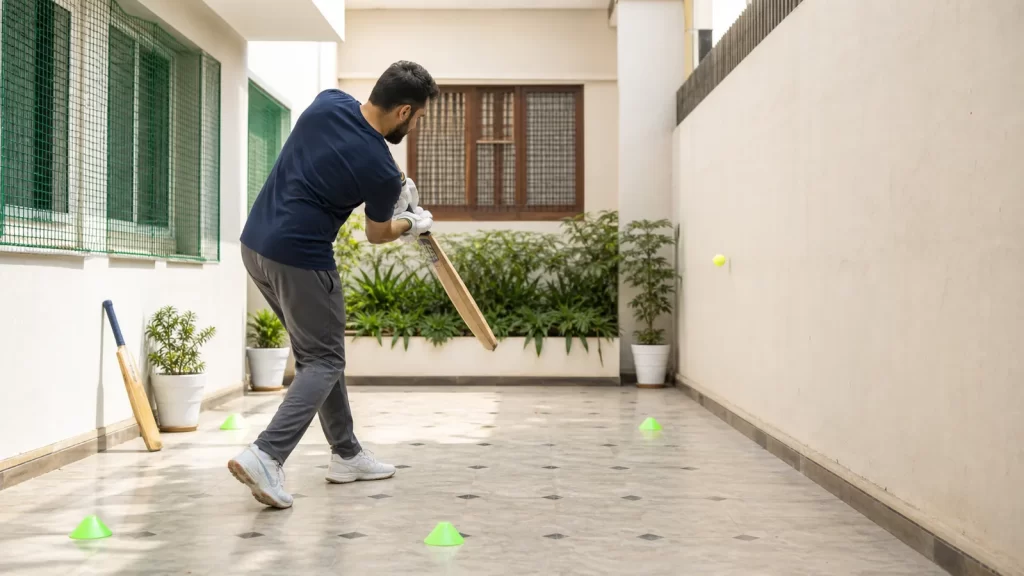
You can improve useful cricket skills alone, but only if the drill has a clear purpose. Hitting a ball randomly against a wall creates activity; it does not automatically create better technique.
Use a soft tennis or training ball, check the surrounding area and never practise where a ball or bat could hit a person, window, vehicle or animal. Leather-ball training belongs in a controlled cricket environment with appropriate equipment.
What You Need
- Tennis ball or soft practice ball
- Cricket bat or safe training bat
- Wall with permission to use it
- Chalk, tape or flat markers
- One stump or a safe target
- Notebook or phone notes for results
Batting Drills
1. Still-head Shadow Batting
Place a marker where your head begins. Complete 20 forward-defence movements and 20 back-foot movements. Finish balanced after every repetition.
2. Hanging-ball Contact
Where safe and permitted, suspend a soft ball so it can swing freely. Make straight-bat contact without trying to hit hard. Count 30 contacts that return the ball along a controlled line.
3. Wall Rebound Defence
Underarm the ball against a wall, set your feet and defend the rebound. Vary the angle only after you can complete ten controlled contacts in a row.
4. One-hand Top-hand Drill
Use a light bat and gentle feed. Guide the ball with the top hand for 12 repetitions. Stop if the bat feels too heavy to control one-handed.
Bowling Drills
5. Run-up Marker Drill
Mark the start and complete ten approaches without bowling. Check whether the front foot arrives near the same place. Rhythm matters more than speed.
6. One-step Target Bowling
From a reduced distance with a soft ball, use one step and focus on release direction. Bowl three sets of six at a marked target.
7. Good-length Scoring Zone
Create a rectangle with tape or chalk. Award two points for the central channel and one for the outer zone. Complete 24 balls and record the score.
8. Wrist-position Rehearsal
Without forcing the shoulder, rehearse release position slowly in front of a mirror. Use this for awareness, not for diagnosing a legal action by yourself.
Fielding Drills
9. Two-hand Wall Catches
Throw a tennis ball against the wall and catch it with relaxed hands. Start with 30 easy catches, then vary height and angle.
10. Alternate-hand Catches
Use gentle rebounds and catch with alternating hands. Keep the body behind the ball rather than reaching dangerously.
11. Ground-ball Pickup
Roll the ball against a wall, move into line, collect with two hands and step toward a target. Complete ten from each direction.
12. Throwing Alignment Without Power
At a short safe distance, point the front shoulder at a target and throw at moderate effort. Count target hits from 20 attempts.
A 25-minute Solo Session
| Minutes | Activity |
|---|---|
| 0–5 | Movement warm-up and shadow batting |
| 5–12 | One batting drill |
| 12–19 | One bowling drill |
| 19–24 | One catching or pickup drill |
| 24–25 | Record results and one observation |
How to Know Whether You Improved
Choose one number: balanced contacts, target balls or clean catches. Keep the drill unchanged for three sessions. Improvement means the number rises while movement remains controlled.
What Solo Practice Cannot Replace
You still need live bowlers, batters, fielders and qualified feedback. A wall cannot teach match communication or fully reproduce pace, bounce and decision-making. Use home practice to prepare a fundamental cricket skill, then test it in nets.

Leave a Reply