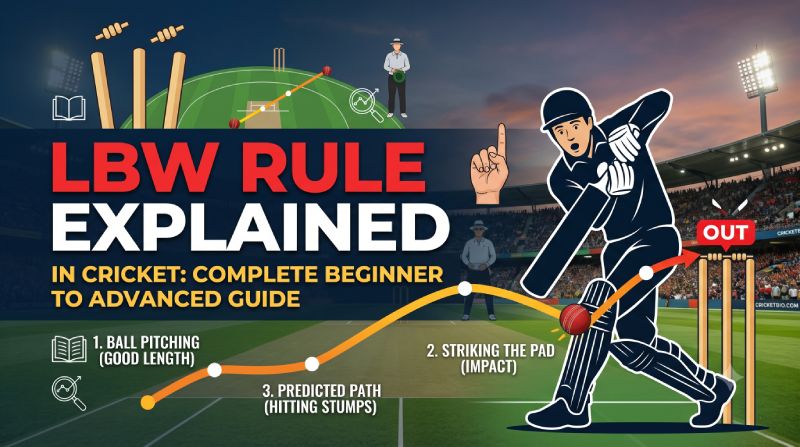
Understand the Leg Before Wicket Rule with Examples, DRS, and Expert Tips
One of the most debated decisions in cricket is LBW (Leg Before Wicket). Whether you’re watching an international Test match, an IPL game, or playing local club cricket, you’ve probably seen players appealing loudly while the umpire carefully decides whether the batter is out.
For beginners, the LBW rule can seem confusing. Many people believe that if the ball simply hits the batter’s leg, it’s automatically out. Others think the ball must always hit the front pad or that an inside edge doesn’t matter. In reality, the LBW law is much more detailed, and umpires must consider several conditions before giving a batter out.
Understanding the LBW rule is important for every cricket fan, batter, bowler, coach, and umpire. Knowing how the rule works not only helps you enjoy the game more but also improves your decision-making on the field. Batters can learn how to avoid LBW dismissals, while bowlers can develop strategies to trap batters in front of the wicket.
In this complete guide, we’ll explain the LBW rule in simple language, discuss how DRS (Decision Review System) helps umpires, look at real match situations, and share practical tips that can improve your cricket knowledge.
Quick Answer: What Is the LBW Rule in Cricket?
LBW (Leg Before Wicket) is a method of dismissal where a batter is given out if the ball strikes any part of their body (usually the leg or pad) before hitting the bat, and the umpire believes the ball would have gone on to hit the stumps.
However, the batter is not automatically out just because the ball hits the pad. The umpire must consider several conditions, including where the ball pitched, where it struck the batter, whether the batter offered a genuine shot, and whether the ball would have hit the stumps.
LBW Rule at a Glance
| Condition | Requirement for LBW |
|---|---|
| Legal Delivery | The ball must not be a no-ball. |
| Ball Pitching | Must not pitch outside the leg stump. |
| Point of Impact | Usually in line with the stumps (or outside off under certain conditions). |
| Ball Trajectory | Must be going on to hit the stumps. |
| Inside Edge | The ball must not touch the bat or glove before hitting the pad. |
If all these conditions are satisfied, the umpire’s hand signal may declare the batter LBW Out.
What Does LBW Mean?
LBW stands for Leg Before Wicket.
It means the batter’s body prevented the ball from hitting the stumps after the ball was delivered by the bowler.
Imagine this simple situation:
A fast bowler bowls a straight delivery.
Instead of hitting the bat, the ball strikes the batter’s front pad.
If the umpire believes the ball would have continued and hit the stumps, the batter can be given out LBW.
The purpose of this law is to prevent batters from unfairly using their legs to stop the ball from reaching the wicket.
Why Was the LBW Rule Introduced?
When cricket was first played, batters sometimes deliberately used their legs to block the ball instead of playing it with the bat.
This made it very difficult for bowlers to dismiss batters.
To keep the game fair, the Leg Before Wicket law was introduced.
The rule encourages batters to:
- Play with the bat rather than the pad.
- Judge the line and length correctly.
- Use proper footwork.
- Play attacking or defensive shots with good technique.
Without the LBW rule, bowlers would struggle to dismiss batters bowling straight deliveries.
Understanding the Five Main Conditions of LBW
Many people think only one thing matters:
“Would the ball hit the stumps?”
Actually, that’s only one part of the decision.
An umpire checks five important conditions before giving LBW.
Let’s understand each one.
Condition 1: The Delivery Must Be Legal
The first requirement is simple.
The ball must be a legal delivery.
If the bowler bowls a no-ball, the batter cannot be given out LBW, even if every other condition is satisfied.
The batter may still be dismissed in other ways (such as run out), but not LBW.
Example –
A fast bowler oversteps the popping crease.
The ball hits the batter’s pad directly in front of the middle stump.
The ball would have hit all three stumps.
Even then…
The batter is NOT out LBW because it was a no-ball.
Condition 2: Where Did the Ball Pitch?
This is one of the most misunderstood parts of the law.
The ball can pitch:
- Outside off stump
- In line with the stumps
- Outside leg stump
Only one of these immediately rules out LBW.
If the Ball Pitches Outside Leg Stump
The batter cannot be given LBW.
This is true even if:
- The ball hits the pad.
- The ball would hit middle stump.
- The batter offers no shot.
Outside leg stump = Not Out
Why?
This protects batters from bowlers who angle the ball excessively from around the wicket.
If the Ball Pitches in Line
LBW is possible.
The umpire checks the remaining conditions.
If the Ball Pitches Outside Off Stump
LBW is also possible.
But more conditions must still be satisfied.
Condition 3: Where Did the Ball Hit the Batter?
After checking where the ball pitched, the umpire checks the point of impact.
Did the ball hit:
- Outside off stump?
- In line?
- Outside leg?
The answer changes the decision.
Impact In Line with the Stumps
This gives the bowler the strongest chance of getting LBW.
If the ball hits:
- Front pad
- Back pad
- Knee
- Thigh
…while in line with the stumps, the umpire continues checking the remaining conditions.
Impact Outside Off Stump
This depends on whether the batter attempted a genuine shot.
Batter Played a Shot
If the impact is outside off stump and the batter attempted to play the ball, the batter is Not Out, even if the ball would have hit the stumps.
This part of the law often surprises new fans.
Batter Did NOT Offer a Shot
Now LBW becomes possible.
If every other condition is met, the batter may be given out.
Impact Outside Leg Stump
A batter cannot be given LBW if the point of impact is outside the line of leg stump.
Condition 4: Would the Ball Have Hit the Stumps?
This is where experience and in professional cricket, technology come into play.
The umpire must judge:
- Line
- Swing
- Seam movement
- Spin
- Bounce
Then estimate whether the ball would have continued to hit the wicket.
This is not always easy.
That’s why international cricket now uses Hawk-Eye ball tracking during DRS reviews.
Example
A right-arm fast bowler bowls a full delivery.
The batter misses.
The ball strikes the front pad directly in front of middle stump.
There is no inside edge.
The umpire believes the ball would have gone on to hit middle and leg stump.
Result: OUT LBW
Another Example
A spinner bowls.
The batter misses.
The ball hits the pad.
However, replays show the ball spinning past the off stump.
Since the ball would not hit the wicket…
Result: NOT OUT
Condition 5: Did the Ball Touch the Bat First?
This is one of the easiest parts of the rule.
If the ball touches:
- Bat
- Glove holding the bat
before hitting the pad…
LBW cannot be given.
This is why bowlers often ask for an inside-edge check during DRS.
UltraEdge helps determine whether the ball touched the bat before striking the pad.
Common Example
A fast bowler appeals loudly.
The umpire is unsure.
DRS shows a tiny spike on UltraEdge before impact with the pad.
The ball clearly touched the bat first.
Decision: Not Out
When Can a Batter NOT Be Given Out LBW?
Understanding when a batter cannot be given LBW is just as important as knowing when they can.
Many appeals look convincing, but one small detail can make the batter Not Out.
Here are the most common situations where LBW does not apply.
| Situation | LBW Possible? |
|---|---|
| Ball is a No Ball | No |
| Ball pitches outside leg stump | No |
| Ball touches the bat before the pad | No |
| Impact outside leg stump | No |
| Impact outside off stump while playing a genuine shot | No |
| Ball would miss the stumps | No |
Understanding these situations helps players avoid unnecessary appeals and improves cricket awareness.
How Does an Umpire Decide an LBW Appeal?
When a bowler appeals for LBW, the umpire quickly evaluates several factors in sequence.
Step 1: Was the Delivery Legal?
The umpire first checks whether the bowler delivered a legal ball.
If it was a no-ball, the decision is immediately Not Out.
Step 2: Where Did the Ball Pitch?
The umpire determines whether the ball pitched:
- Outside off stump
- In line
- Outside leg stump
If it pitched outside leg stump, the batter cannot be out LBW.
Step 3: Did the Ball Hit the Bat First?
The umpire listens and watches carefully.
If the ball touched the bat or glove before striking the pad, LBW is ruled out.
Step 4: Where Was the Point of Impact?
The umpire checks where the ball struck the batter.
This is especially important when the batter offers a shot.
Step 5: Would the Ball Have Hit the Stumps?
Finally, the umpire judges the future path of the ball.
Only if the ball would have hit the wicket can the batter be given out.
This entire process often takes only a few seconds during live play.
How Does DRS Help in LBW Decisions?
Modern cricket uses the Decision Review System (DRS) to assist umpires with close LBW decisions.
DRS combines several technologies to reduce human error and improve fairness.
The main technologies include:
- Hawk-Eye Ball Tracking
- UltraEdge (Snickometer)
- Ball Tracking Simulation
These tools help confirm whether the umpire’s original decision was correct.
Hawk-Eye Ball Tracking Explained
Hawk-Eye uses multiple high-speed cameras placed around the stadium.
The system tracks:
- Ball speed
- Swing
- Seam movement
- Bounce
- Spin
- Final trajectory
It then predicts whether the ball would have gone on to hit the stumps after striking the batter.
This technology is now an essential part of international cricket.
What Is Umpire’s Call?
One of the most confusing terms for cricket fans is Umpire’s Call.
It does not mean the technology is incorrect.
Instead, it means the prediction is so close that the original on-field decision is allowed to stand.
Example
The umpire gives the batter Not Out.
The bowling team reviews.
Hawk-Eye shows the ball clipping only a small part of leg stump.
Because the prediction is extremely close, the result becomes:
Umpire’s Call – Not Out
If the umpire had originally given the batter out, the decision would have remained Out.
Common LBW Myths
Many cricket fans misunderstand the LBW law.
Let’s clear up some common myths.
| Myth | Reality |
|---|---|
| Ball hits the pad = Out | Wrong. Several conditions must be satisfied. |
| Ball must hit the front pad | Wrong. It can hit any part of the body. |
| Ball pitching outside off can never be LBW | Wrong. It can still be LBW if other conditions are met. |
| Every inside edge means Not Out | Correct. If the ball touches the bat first, LBW is not possible. |
| DRS always changes umpire decisions | Wrong. Many reviews end with Umpire’s Call. |
Understanding these myths helps fans enjoy the game with greater confidence.
Real Match Scenarios
Scenario 1: Fast Bowler
A right-arm fast bowler delivers a full ball.
The batter misses the drive.
The ball strikes the front pad in line with middle stump.
There is no inside edge.
Ball tracking shows it would hit middle and leg stump.
Decision: OUT LBW
Scenario 2: Spinner
A left-arm spinner bowls around the wicket.
The ball pitches outside leg stump.
It hits the batter directly in front of the wicket.
Although the ball appears to be hitting the stumps…
Decision: NOT OUT
Why?
Because the ball pitched outside leg stump.
Scenario 3: Batter Offers a Shot
The ball pitches outside off stump.
The batter attempts a defensive stroke.
The ball hits the pad outside off stump.
Ball tracking predicts it would hit middle stump.
Decision: NOT OUT
Because the batter attempted to play a genuine shot.
Scenario 4: No Shot Offered
The batter leaves the ball without attempting a stroke.
The impact is outside off stump.
The ball would hit middle stump.
Decision: OUT LBW
Tips for Batters to Avoid LBW
Good batters don’t just rely on luck.
They use sound technique to reduce the chances of being trapped in front.
Watch the Ball Closely
Follow the ball from the bowler’s hand until it reaches the bat.
Improve Footwork
Move your front foot towards full deliveries.
Against spin, use your feet confidently.
Play with a Straight Bat
Straight-batted shots reduce the risk of LBW.
Avoid Falling Across the Stumps
Many beginners move across too far, exposing their pads.
Maintain balance throughout your innings.
Trust Your Defence
Not every ball needs to be attacked.
Sometimes, a solid defensive shot is the safest option.
Tips for Bowlers to Get More LBW Wickets
LBW is one of the most rewarding dismissals for bowlers.
Here are some proven strategies.
1. Bowl Fuller Lengths
Full deliveries are more likely to strike the pad before the bat.
2. Target the Stumps
Consistently bowl at off stump and middle stump.
This forces the batter to play every ball
3. Swing the Ball
Late swing makes it difficult for batters to judge the line.
Many famous LBW dismissals come from late inswing.
4. Vary Your Pace
Changing speed can surprise the batter and create LBW opportunities.
5. Build Pressure
Dot balls force batters into mistakes.
Pressure often leads to poor footwork and LBW chances.
LBW in Different Cricket Formats
Although the law remains the same across formats, batting approaches differ.
| Format | How LBW Influences Batting |
|---|---|
| Test Cricket | Batters play with patience and strong defence, reducing LBW chances through disciplined technique. |
| ODI Cricket | Players balance attack with caution, especially during middle overs where bowlers target the stumps. |
| T20 Cricket | Aggressive stroke play increases the risk of LBW, particularly against yorkers and straight deliveries. |
| Tennis Ball Cricket | Formal LBW rules often vary by local tournaments. Always check the competition’s playing conditions. |
Expert Tips from Cricket Coaches
Experienced coaches often emphasize these habits:
- Keep your head still while batting.
- Watch the seam of the ball.
- Move your feet before your bat.
- Don’t plant your front foot too early.
- Respect straight deliveries.
- Practice against both pace and spin.
- Learn from every dismissal.
Remember:
Strong batting technique is the best defence against LBW.
Frequently Asked Questions
Q1. What does LBW stand for?
LBW stands for Leg Before Wicket, a method of dismissal where the batter blocks the ball with their body before it can hit the stumps, provided all conditions of the law are met.
Q2. Can a batter be LBW if the ball pitches outside off stump?
Yes. A batter can be out LBW if the ball pitches outside off stump, provided the point of impact and all other conditions satisfy the law.
Q3. Can a batter be LBW if the ball pitches outside leg stump?
No. If the ball pitches outside leg stump, the batter cannot be given out LBW.
Q4. Does an inside edge save a batter from LBW?
Yes. If the ball touches the bat or glove (holding the bat) before hitting the pad, the batter cannot be dismissed LBW.
Q5. What is Umpire’s Call in DRS?
Umpire’s Call means the predicted ball path is too close to overturn the original on-field decision, so the umpire’s decision stands.
Q6. Why do bowlers appeal loudly for LBW?
The umpire can only give a batter out after the fielding side makes an appeal. Loud appeals are a natural part of the game, but the decision always rests with the umpire.
Final Thoughts
The LBW rule is one of cricket’s most important laws because it ensures a fair contest between bat and ball. While it may seem complicated at first, understanding the five key conditions makes the decision much easier to follow.
Whether you’re a player aiming to improve your technique, a bowler looking to increase your wicket tally, or a fan wanting to understand umpiring decisions better, learning the LBW law will deepen your appreciation of the game.
The next time you watch a close LBW appeal, don’t focus only on where the ball hit the pad. Think about the complete sequence, where the ball was pitched, whether the batter played a shot, where the impact occurred, and whether the ball would have hit the stumps. That’s exactly how umpires and modern technology arrive at the correct decision.

Leave a Reply